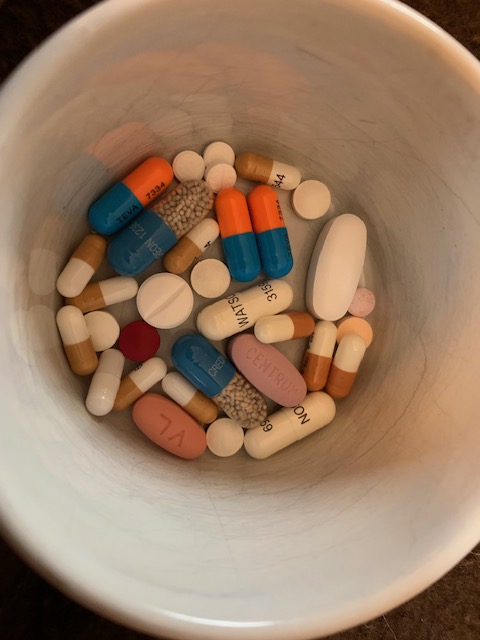
I thought I could get away with one post on recuperation and recovery, but here’s a bonus one because some people asked me about ongoing care. Which leads me right into a short discussion on health care.
See the photo? That’s the number of pills I had to take in the morning every day. There were more pills to take mid-day and then before bed. This represents nine different medications and the rest are vitamins and minerals. I have a prescription for the vitamins and minerals but I now just buy them at Walgreens over the counter because it’s easier. The medications are what you’d expect of a transplant patient: Tacrolimus to prevent organ rejection as well as Mycrophenelate and Prednisone, which are immunosuppressants since I’m going to be compromised for the rest of my life. The other medications were necessary but temporary for liver health, pancreas stimulation and others to boost my immune system. After a few months, I was able to stop four of the meds but I will take the big five for the rest of my life. I also take Vitamins B-12 and D3, Calcium, Iron, baby aspirin for clotting, and a cranberry pill to prevent UTIs.
I would say that it’s a small price to pay to have a life, but that’s not true for some people. After the surgery, someone from the hospital pharmacy came to see me to go over these medications and how I would obtain them. They would send me home with a month’s supply, but after that the prescriptions would be called into my pharmacy of choice, and then I’d be responsible for ensuring that I had them based on my medical/prescription drug insurance. The most important ones would be automatically renewed without any intervention on my part, which is a great system.
Based on your insurance, your out-of-pocket cost for these medications can be upwards of $15,000 a month. A MONTH. This is when I started freaking out, because I had no idea what my insurance would pay. The pharmacists and doctors assured me that there was no way they would allow me to have to forego the medication, and that we would find a way. The pharmacist said she would run a cost-analysis to see what my co-pay would be and have it for me the next day. I stressed all night long about how I was going to pay for this. I started looking into Medicare Part B, D, whatever the situation allowed for (I was about to be approved for Social Security Disability, so Medicare itself would be offered at a certain point).
The next day, the pharmacist arrived with her figures. To my complete shock, my co-pay would be…….$0. That’s correct. Thanks to Tony, who worked for the federal government, I am a member of the Blue Cross/Blue Shield Federal Health Plan, one of the best ones out there. And as his widow, I am allowed to be a member for the rest of my life (even if I remarry). This also means that they paid for my entire hospital stay, surgery, anesthesia, all those blood tests, MRIs, CT scans, X-Rays, PT, dialysis, psychiatric counseling and so much more. Another reason I am sooooooo lucky.
What if I had terrible insurance, like so many other Americans do? What if my co-pay for prescriptions was in the thousands every month? What if I had a staggering hospital bill waiting for me when I finally got home? I’ve heard the horror stories, too. And believe me, I am not bragging. I am pointing out the discrepancy. I’m not rich, and I’m in the same financial boat as most people. It’s really a stroke of good fortune that I don’t have to worry. So why is it fair that so many millions of people do, or don’t have the kind of insurance that would even pay for a transplant (I’m assuming)? Is it “you can’t pay, so you die?” I just don’t know. According to data from the United Network for Organ Sharing, the average cost of surgery alone is $1.5 million. There are organizations that offer support, financing, fundraising (I suppose a GoFundMe would work for some of it) but still. What a mountain to climb.
I am not going to get into a debate on the pros and cons of the U.S. healthcare system. We all know it needs serious improvements. But I have to say, regardless of the cost, there is nowhere I’d rather be than here for this type of surgery and post-surgical care. Thankfully, I can afford it. I really, really hope that soon everyone can.




 The Sober Widow
Leave a comment